

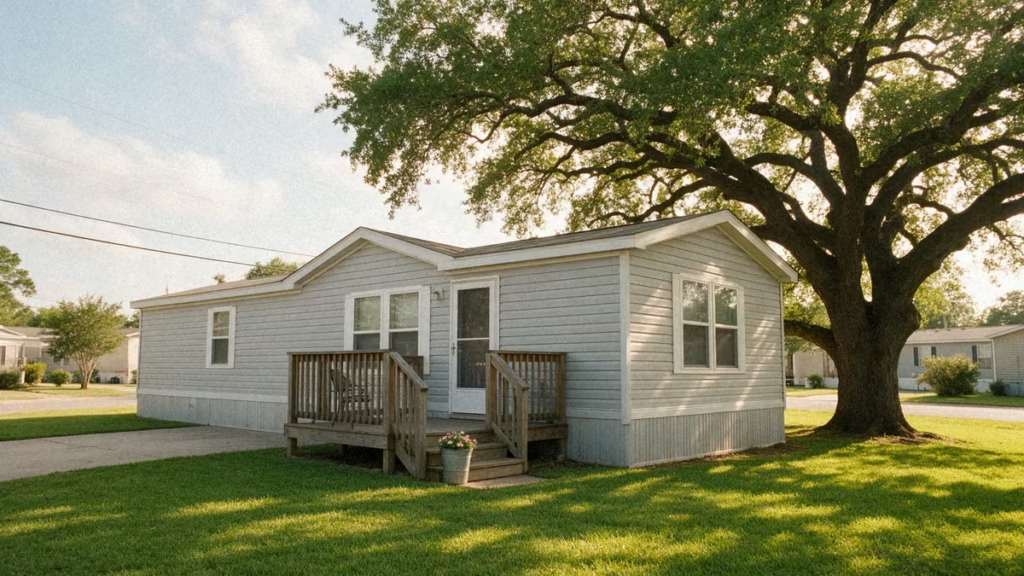
Learning how to buy a mobile home in Texas with cash comes down to a handful of steps: decide where the home will sit, check its ownership and lien record with the Texas Department of Housing and Community Affairs (TDHCA), inspect it, plan any move, then pay and file the ownership transfer. Texas doesn’t use a car-style title for these homes. TDHCA records ownership on a Statement of Ownership, and the application to transfer it is due within 60 days of the sale.
The step that protects your money comes before you pay: look up the home’s TDHCA record and make sure the seller is the owner and the record shows no liens.
How to buy a mobile home in Texas, step by step
The steps below go in the order you’ll do them. Each one links to a deeper guide if you need more detail.
Step 1: Decide where the home will go
Where the home ends up changes the paperwork and the costs. It also tells you which listings to skip.
One option is a mobile home park. Many used homes are sold right where they sit. You buy the home and rent the lot underneath it from the park. The park decides whether to accept you as a tenant, usually through an application. Under the Texas Property Code, a park that receives your application has to give you its proposed lease, its community rules, and a written statement of your rights as a tenant, including the initial lease term and how much notice the park must give before it declines to renew.
Homes we list in a park are sold to stay in that park. We work directly with parks, so we can point you to the right park contact. The park approves you in writing before you pay. If you want a home that’s already set up, start with homes already placed in Texas parks, and read what park approval and lot rent involve before you apply.
The other option is land you own or plan to buy. You’ll need to move and install the home, and the land has to allow it. Before you buy a home to move, check deed restrictions, any HOA rules, county rules, and whether the land sits inside city limits. You’ll also need water, power, and a way to handle wastewater, which on rural land often means a septic system that needs a permit. Our guide to putting a mobile home on your own land covers those checks.
Step 2: Know what kind of home you’re looking at
People use “mobile home” and “manufactured home” for the same thing, but there’s a legal line between them. Homes built after June 15, 1976, meet the federal HUD code, and the law calls them manufactured homes. Homes built before that date are mobile homes in the strict sense.
The home itself tells you what you’re buying:
- Each section of a home built after June 15, 1976, carries a HUD label, a red metal tag about 2 by 4 inches. Each label has its own number.
- The data plate, a paper label usually near the main electrical panel, lists the manufacturer, the serial number, the build date, and the wind zone the home is rated for.
- The serial number works as the home’s ID number. You’ll find it on the data plate and on the home’s TDHCA record.
Write down the serial number and the HUD label number. You need both to look up the home’s record in Step 3.
The wind zone matters on the Gulf Coast. HUD places 15 Texas coastal counties, including Galveston, Brazoria, Nueces, and Cameron, in Wind Zone II. If the home will end up in one of those counties, confirm with your installer that it’s rated for that zone before you buy.
Then there’s size. A double wide moves in two sections that the installer joins on site, so it takes more planning than a single wide. If you’re still deciding, compare single wide and double wide homes on budget and lot size.
Step 3: Check ownership and liens before you pay
We check each home’s TDHCA record for liens before we list it, and you should still run the search yourself. Search the home in TDHCA’s manufactured housing records database with the serial number and the HUD label number, or the Texas Seal number for some older homes. When the record comes up:
- Match the owner’s name to the person or business selling you the home. If they don’t match, stop and ask why.
- Look for mortgage liens. A lien means a lender still has a claim on the home. Ask how and when the lender will release it, and get that answer in writing before you pay.
- Check for tax liens. Unpaid property taxes on a manufactured home show up in TDHCA’s records as tax liens. TDHCA also offers a separate tax lien search.
The record also shows whether the home is personal property or real property. Personal property is the default. A home converted to real property goes with the land under it and changes hands through county deed records, so have a title company or a Texas real estate attorney handle that kind of purchase.
Our guides explain how the Statement of Ownership works and how to check a home for liens.
Check the seller, too. If you’re buying from a dealer, confirm its TDHCA retailer license with the TDHCA license holder search. We also walk through how to verify a dealer’s license step by step. Buying from a private owner instead? See how to buy a mobile home from a private seller.
Step 4: Inspect the home
Used homes vary a lot. Some are ready to move into and some need work, and each of our listings says which. We sell every home as-is, as described, and you can tour any of them and bring an inspector.
Hire an inspector who knows manufactured homes, and pay attention to:
- Floors, especially soft spots near the bathroom, kitchen, and exterior doors
- Ceiling stains and the roof above them
- Leaks under sinks and around the water heater
- The electrical panel, heating, and air conditioning
- Windows and doors that stick or don’t latch
- If you plan to move the home, the frame and anything that affects transport
Use a full used mobile home inspection checklist on the tour, and bring a list of questions to ask before you buy.
Step 5: Plan the move and setup
Skip this step if you’re buying a park home that’s staying put. If you’re moving a home to your land, plan the move before you buy.
We don’t deliver or set up homes, so you’ll hire two kinds of help: a mover and a TDHCA-licensed installer.
Moving a home that’s over Texas legal size limits takes a single-trip permit from the Texas Department of Motor Vehicles. A licensed motor carrier can get one. So can an owner whose name is on the title, who owns or leases the towing vehicle, and carries at least $300,000 in liability insurance. TxDMV’s permit page lists the rules. Most buyers hire a mover who handles the permit.
The installer levels and anchors the home, joins the sections, and connects it to utilities. They also have to report the installation to TDHCA within 7 days of the job. You can check an installer’s license with the same TDHCA license search.
Get at least two written quotes. Ask each company what’s included: permits, escorts, blocking, anchors, skirting, steps, and utility hookups. The guide to moving a mobile home in Texas walks through costs and timing.
Step 6: Pay for the home
We sell for cash only, with no financing. You pay in full by cashier’s check, verified wire transfer, or cash, and if you wire the money, someone on our team talks with you directly to settle the payment. We don’t take deposits or hold homes. A home goes to the first buyer who pays in full.
Wire fraud is a real risk in any cash purchase. Before you send a wire, confirm the instructions by calling the seller at a phone number you already know, not one from an email. Never send money for a home you haven’t seen and checked in TDHCA records. Read more about paying cash safely and the scams buyers run into.
Step 7: File the Statement of Ownership transfer
A Texas sale of a used home comes with four pieces of paperwork:
- A bill of sale or purchase agreement that shows the sale date, price, buyer and seller names, and the home’s serial and HUD label numbers.
- An Application for Statement of Ownership, filed with TDHCA within 60 days of the sale, with the $55 fee. The current form makes notarization optional, but signing in front of a notary costs little and removes doubt.
- A tax statement from the county tax assessor-collector showing the home’s property taxes are paid. What it has to show depends on the time of year. For a sale in October through December, it confirms the current year’s taxes are paid in full.
- A choice on the application of personal property or real property.
Under Texas law, ownership doesn’t pass to you until someone files a completed application with TDHCA, so don’t let the 60 days slide. A late filing can also cost the seller a $100 fee and hold up your Statement until someone pays it. When you buy from a licensed retailer, the retailer has to supply TDHCA with the documents and fees it needs. In a private sale, you and the seller handle it, using TDHCA’s forms.
When you buy from us, ownership transfers through TDHCA after payment, and we file the application and get the tax statement, with a copy for you. See how buying from us works.
Property taxes on the home go to the county where it sits. Whether sales tax applies to a used home is a separate question, so confirm it with the Texas Comptroller or a CPA before you budget. Our guide to what a used mobile home really costs breaks down the full budget.
What a used mobile home costs: in a park vs. on your land
The homes we sell typically run from about $15,000 to $100,000, depending on size, age, and condition. The price is only part of the budget, though. The rest depends on where the home will sit:
| Cost | Home that stays in a park | Home moved to your land |
|---|---|---|
| TDHCA ownership application | $55 | $55 |
| Lot rent | Monthly, set by the park | None |
| Moving and permit | None | Mover’s quote |
| Installation and setup | Already in place | Installer’s quote |
| Water, power, septic, driveway | Usually in place | Depends on the land |
| Insurance and property taxes | Yes | Yes |
Common mistakes cash buyers make
- Paying before checking the TDHCA record. A clean record and a matching owner name come first.
- Not reading the park’s lease and rules. Ask for them early. Pets, vehicles, and additions are common sticking points.
- Buying a home to move before checking the land. Deed restrictions, city limits, and wind zone can all rule a home out.
- Skipping the inspection. An inspector who knows manufactured homes will catch what a quick walk-through misses.
- Missing the 60-day filing deadline. Ownership doesn’t pass until someone files a completed application.
- Trusting wire instructions in an email. Confirm them by phone at a number you already have.
Before you tour a home
Start with homes that fit your plan: one already in a park, or one you can move to your own land. Read each listing’s condition notes, then tour your top picks with an inspector. You can browse the homes we have for sale now. If nothing fits yet, use the alert form on this page to hear about new listings.
Frequently Asked Questions
Do you get a title when you buy a mobile home in Texas?
Not a car-style title. Texas records manufactured home ownership on a Statement of Ownership issued by TDHCA. After a sale, a completed Application for Statement of Ownership is due to TDHCA within 60 days, with a $55 fee.
How do I check if a mobile home has a lien in Texas?
Search TDHCA’s manufactured housing records online using the home’s serial number and HUD label or Texas Seal number. The record shows the current owner and any mortgage or tax liens. Do this before you pay anything.
How long do I have to transfer a mobile home into my name in Texas?
The application for a new Statement of Ownership is due to TDHCA within 60 days of the sale. Ownership doesn’t officially pass until someone files a completed application, so file well before the deadline.
Can I buy a mobile home in a park and move it?
It depends on the seller and the park. Homes we list in a park are sold to stay in that park. For other homes, check the park’s rules first, then hire a mover and a TDHCA-licensed installer.
Who gets the permit to move a mobile home in Texas?
The Texas Department of Motor Vehicles issues single-trip permits for oversize homes. A licensed motor carrier can get one, and so can an owner named on the title who owns or leases the towing vehicle and carries at least $300,000 in liability insurance.
Sources Reviewed
- TDHCA: Manufactured Housing Division
- TDHCA: Frequently Asked Questions: Statement of Ownership
- TDHCA: Helpful Guidelines, MHD Form 1112 (effective May 17, 2023)
- TDHCA: Manufactured Housing Rules, 10 TAC Chapter 80 (effective December 21, 2025)
- TDHCA: Tax Lien Information
- Texas Occupations Code, Chapter 1201: Manufactured Housing
- Texas Property Code, Chapter 94: Manufactured Home Tenancies
- TxDMV: Manufactured Housing Single-Trip Permits
- HUD: Manufactured Housing Homeowner Resources
- 24 CFR 3280.305: Wind zones
Last reviewed: October 7, 2026